
Looking Back To See What’s Ahead
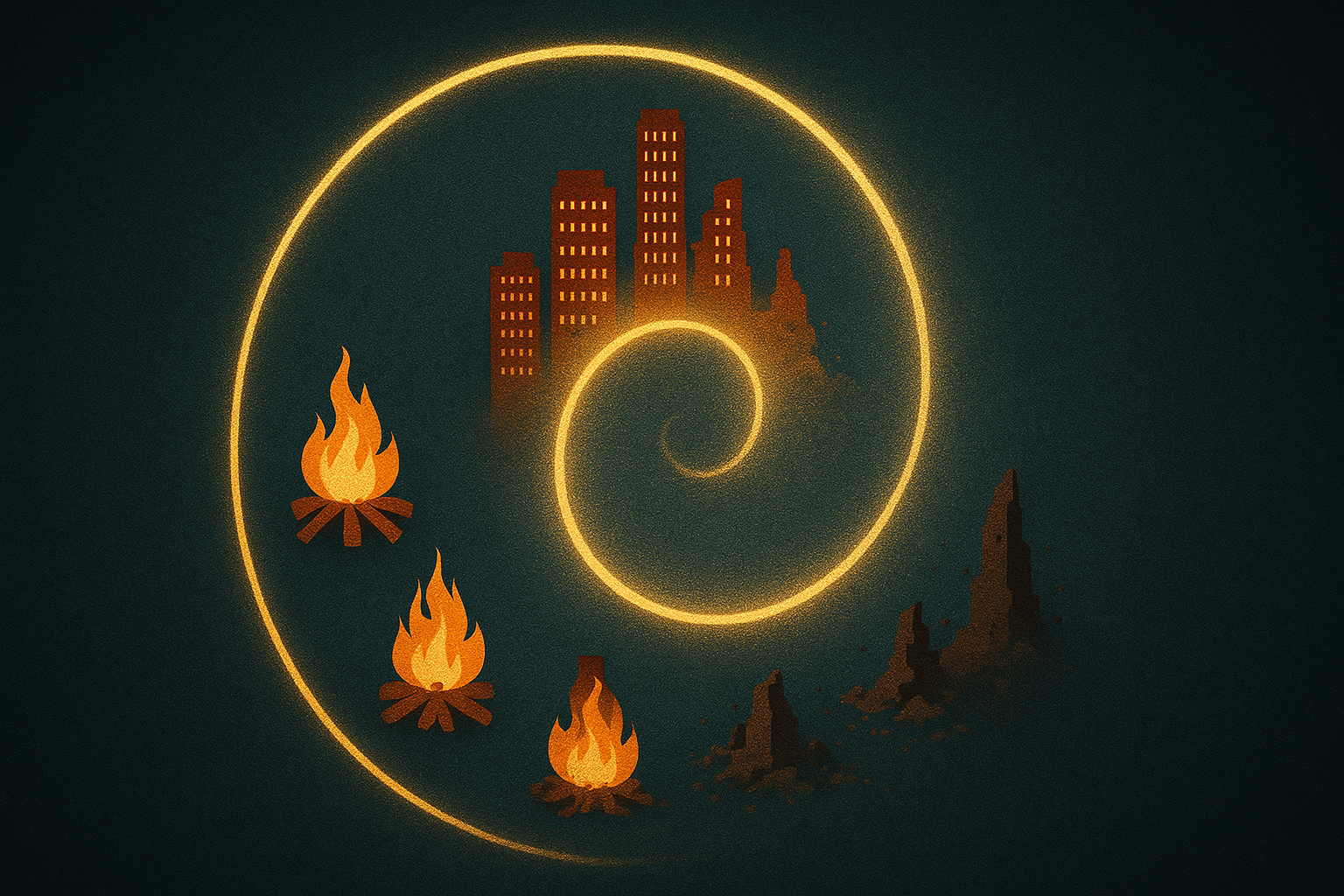
For most of human history, we lived as hunter–gatherers. Our shelters, alliances, and rules were temporary by design. People constantly experimented, shifting social arrangements with the seasons. That flexibility was our true survival skill.
Agriculture and cities changed everything. Larger systems took root: empires, bureaucracies, organized religions. They brought stability and scale, but also rigidity. Once these systems stopped serving their people, collapse followed. In truth, even our modern states are just bigger versions of temporary camps: fragile unless renewed by fairness, reform, or shared purpose.
What ultimately holds societies together are the stories we tell and believe in. When those myths stop resonating, even the strongest-seeming structures unravel.
The Last Hundred Years
The 20th century was humanity’s most dramatic leap. We endured two world wars, the collapse of empires, and the rise of nuclear stalemate. Science expanded our horizons, while technology connected billions.
The postwar order created stability, but also masked fragility: deep inequality, shallow media culture, and uneven growth. By the century’s end, globalization spread prosperity selectively, leaving many communities adrift.
The Cold War, for all its danger, at least offered people clear “good vs. evil” stories. After 1991, those dissolved. Complexity reappeared in tangled financial systems, sprawling bureaucracies, and fragile supply chains. The COVID crisis made that brittleness impossible to ignore.
Fiction writers captured the tension. Some imagined communities scraping by after collapse, inventing new belief systems. Others pictured a near future where nations were pawns of elites and military blocs. Both visions remain relevant: either we adapt and reinvent, or we fracture further.
America and the World Now
The United States today embodies both promise and peril. There is no longer one American story, only fragmented versions competing for attention. Media ecosystems thrive on outrage, feeding more heat than light.
Trump’s felony conviction, the assassination of Charlie Kirk during a campus speech, and the wildfire of disinformation around both are symptoms of that fragmentation. Each side spins events into competing “truths.”
Economically, the U.S. remains wealthy and innovative, but its complexity is becoming a trap: soaring debt, legal gridlock, and systems too tangled to reform. Many working-class men and boys struggle to adapt, fueling resentment that extremist movements exploit. Abroad, America’s contradictions erode trust at home and weaken its standing abroad.
Culturally, the absence of a unifying myth leaves the nation adrift. Communities feel fragile, searching for new belief systems. Science, reason, and shared values could ground us… if we choose them.
Globally, the same fragility shows up. Israel and Gaza are locked in cycles of war and humanitarian disaster. Europe strains under the long Ukraine conflict. China expands its influence through trade and technology. The Global South pushes for new institutions as climate shocks hit hardest. Everywhere, old “camps” look unstable, and new ones are being built.
What Comes Next
History suggests we shouldn’t expect permanence. Hunter–gatherers thrived because they knew when to move on, when to abandon brittle arrangements and try something new.
Our systems today, political, economic, cultural, will endure only if they adapt. The danger is clinging to myths that no longer work. The opportunity is inventing fairer, more resilient ones.
The next few years may not be defined by winners and losers, but by whether we remember our deepest survival skill: flexibility. Can we leave behind exhausted camps and create new ones before collapse forces our hand?