
Who Really Pays for AI’s Growing Appetite for Power?
Artificial intelligence isn’t just transforming industries, it’s transforming the grid. By now, most people have heard that data centers use staggering amounts of electricity. What’s less obvious is how those costs ripple outward, often ending up on the bills of ordinary consumers.
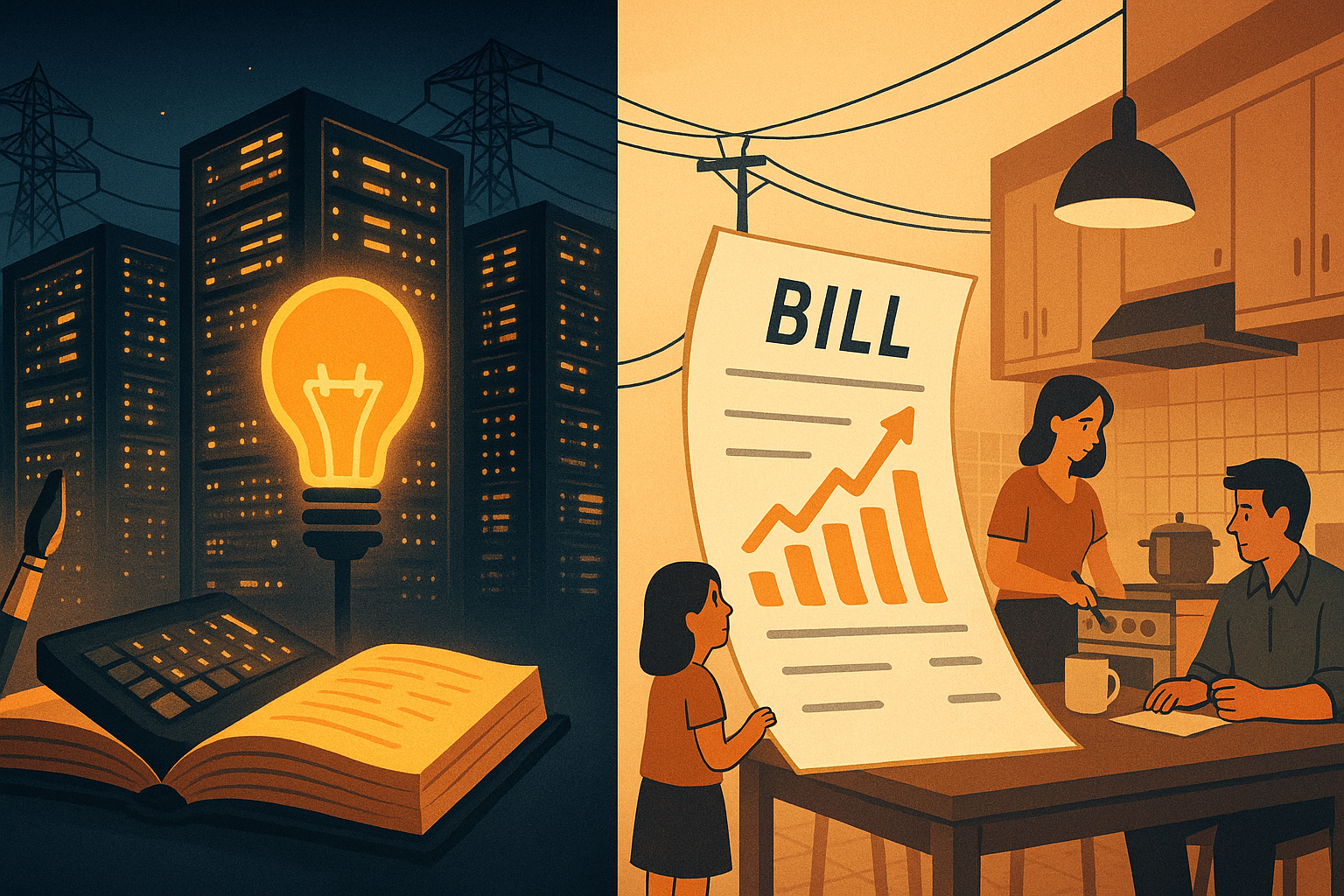
When a hyperscaler announces a new AI campus, utilities can’t simply plug it in. They need to plan, permit, and finance new power plants, transmission lines, and substations to meet the demand. That’s billions of dollars in infrastructure, and utilities recover those costs the same way they always have: by spreading them across their rate base. In other words, you.
The dynamic gets more complicated because Big Tech often negotiates favorable electricity contracts. Special tariffs or incentives keep their costs stable, while utilities balance the books by raising rates on households and smaller businesses. In Louisiana, regulators recently approved three new gas turbines and a half-billion-dollar transmission project to serve Meta’s data center, with cost recovery flowing back to ratepayers. In the Mid-Atlantic’s PJM grid, capacity auction prices have jumped thanks in part to data center growth, and customers are bracing for 1–5% bill increases.
Zoom out and the numbers get bigger. A DOE-backed study projects that U.S. data centers could nearly triple their electricity consumption by 2028, from around 4% of the nation’s load to 12%. McKinsey estimates a 23% compound annual growth rate in data-center demand through the end of the decade. Meeting that load will require massive investments in firm, around-the-clock power like nuclear, geothermal, natural gas with carbon capture, and the transmission networks to deliver it. Those resources are more expensive than just adding solar or wind, and the financial burden is being decided now in utility commission hearings across the country.
So what does this mean for consumers? Expect bills that creep upward not just because of inflation, but because you’re indirectly financing infrastructure designed for hyperscale AI. Expect higher fixed charges, which guarantee utilities steady revenue even if you conserve energy. Expect more volatility in markets reliant on natural gas or facing transmission bottlenecks. For most households, that translates into 5–15% higher bills over the next decade, with sharper spikes in regions hosting large clusters of data centers.
The question isn’t whether AI will reshape the energy landscape, it already has. The question is whether regulators will ensure that the companies driving this growth shoulder the proportional cost of the infrastructure they require, or whether ordinary ratepayers will quietly subsidize the future of artificial intelligence.